
Reverse-engineering
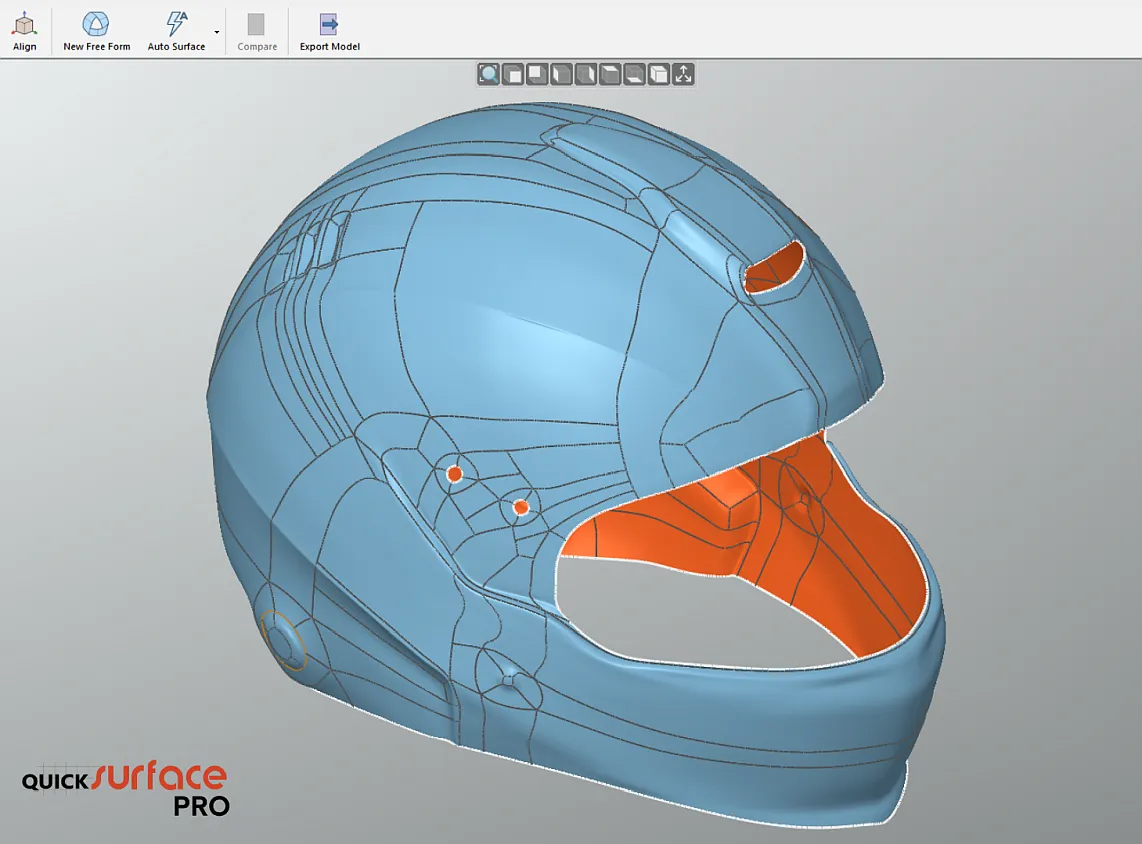
Automatic Surfacing Tools
Software such as Autodesk Fusion 360 and QuickSurface offers efficient semi-automatic workflows to convert mesh data into CAD geometry.
Fusion 360 is capable of generating clean, well-structured surfaces for most mechanical parts. It works particularly well with defined geometries such as planes, cylinders, holes, and fillets. For prismatic or feature-based components, it can produce organized and editable CAD models.
However, when it comes to complex free-form surfaces, the generated geometry is often difficult or impossible to meaningfully refine afterward because the surface itself has no handles like CVs (Control Vertics) to pull or push. That means the shape of an individual freeform surface is fixed, although you can move it around.
QuickSurface, on the other hand, can automatically cover highly complex organic shapes. The trade-off is that the result typically consists of heavy, dense NURBS surfaces. These surfaces are mathematically complex and practically “dead” — they lack clean topology and cannot be modified in a controlled way with CVs. As a result, while the shape may look correct, further design development or surface optimization is extremely limited and it can only get as good as the scan was.
Advanced Metrology-Driven Systems
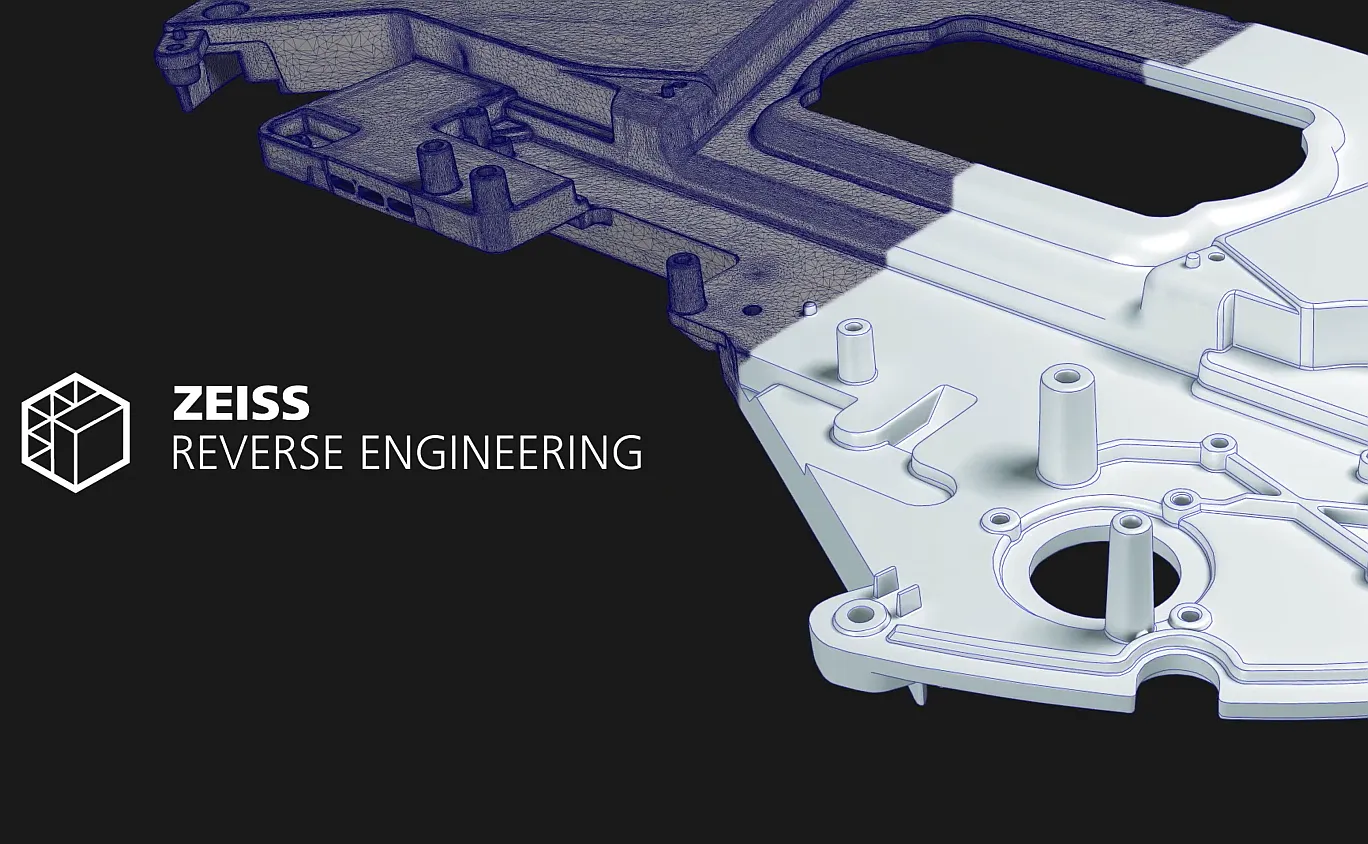
Industrial platforms such as ZEISS Reverse Engineering are built on decades of optical measurement expertise. Combined with high-end hardware from ZEISS, these systems deliver extremely accurate scan data and strong hybrid workflows that connect inspection, deviation analysis, and surface reconstruction.
For functional mechanical parts, cast components, tooling inserts, or precision assemblies, they are outstanding. They allow controlled surface fitting, feature extraction, and validation against tolerances. In many industrial contexts, this level of precision and traceability is exactly what is required.
However, there is a common misconception that metrology-driven reverse-engineering software can fully replace high-end automotive surfacing workflows. While these systems can generate smooth surfaces and even allow partial retouching, they are primarily optimized for measurement accuracy and feature reconstruction — not for the aesthetic and structural logic required in complex automotive Class-A body design.
Automotive exterior surfaces demand intentional topology, structured patch layouts, highlight control, and flawless curvature flow across large connected areas. Even if a surface appears smooth in zebra or curvature analysis, achieving production-level reflection quality requires more than automated fitting or tolerance-driven modeling. Without the expertise of a dedicated automotive digital modeler — working in environments such as Autodesk Alias SurfaceStudio — the results rarely meet professional OEM bodywork standards.
And this is exactly where the transition begins: from measurement-driven reconstruction to true Class-A surface development — where geometry is not only accurate, but fully controlled, intentional, and ready for high-end automotive production.
High-End Class-A Surfacing — The Precision of Alias SurfaceStudio
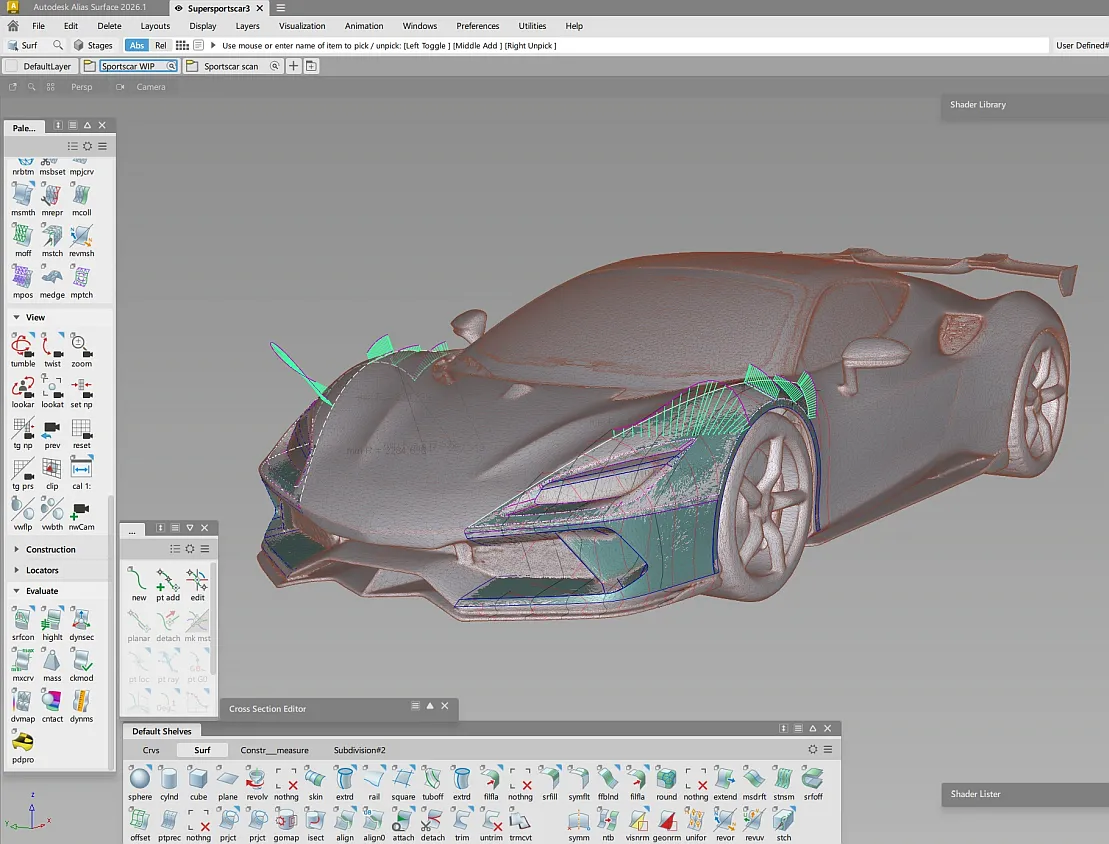
For truly accurate remodeling of complex free-form shapes — especially in automotive exterior and interior design — no automatic or metrology-driven system can match the precision, control, and creative flexibility of Autodesk Alias SurfaceStudio. This is the environment where real Class-A geometry is built, refined, and validated.
Alias SurfaceStudio is engineered specifically for premium design surfacing, offering a level of control that goes far beyond “surface fitting.” It provides real-time evaluation tools, such as curvature combs, Gaussian curvature maps, zebra stripes, chrome shaders, and environment reflections. These visual diagnostics allow designers to immediately inspect highlight flow, surface tension, panel transitions, and overall aesthetic quality.
For manufacturing-driven projects, Alias includes draft-angle and tooling-direction visualization, enabling designers to check undercuts, mold release directions, and production constraints directly inside the modeling environment. Real-time dynamic sections in X, Y, Z — as well as custom section planes — help ensure geometric fidelity at every stage.
What sets Alias apart is its advanced continuity and alignment system, allowing precise control of G0 (position), G1 (tangency), G2 (curvature), and G3 (curvature acceleration) between surfaces. These continuity tools are essential for automotive surface development, where even micro-distortions in curvature can ruin the flow of reflections across body panels. Alias not only corrects these transitions — it lets the modeler sculpt and control them with millimeter-level precision.
Unlike most automatic reverse-engineering tools, Alias can generate surface patches directly from mesh data, but with full interactive control of it shape through the CVs. Those can be manipulated in normal directions, sliding in U and V and in non-proportional scale. The designer decides patch layout, topology flow, and curvature strategy. It is not about “covering” the mesh — it is about re-creating the design intent with clean, editable NURBS geometry.
A unique strength of Alias is the ability to construct curves and surfaces based on spatial feature-curve logic. Feature curves can be placed freely in 3D space — not restricted to the mesh surface — enabling the designer to reinterpret, refine, or improve the underlying form. This is crucial when rebuilding clay models or scanned concept surfaces, where the goal is not merely to replicate but to enhance the design in a controlled Class-A workflow.
In short, Alias SurfaceStudio is not just a tool to convert scans into surfaces — it is a professional modeling environment that allows artists, designers, and engineers to create mathematically perfect, aesthetically refined, and production-ready Class-A geometry.
This level of precision requires both the right software and the right expert. High-end surfacing environments only reach their true potential when handled by a consultant with decades of real automotive modeling experience — such as Scanprint-3D, bringing over 30 years of specialized Class-A and reverse-engineering expertise.

